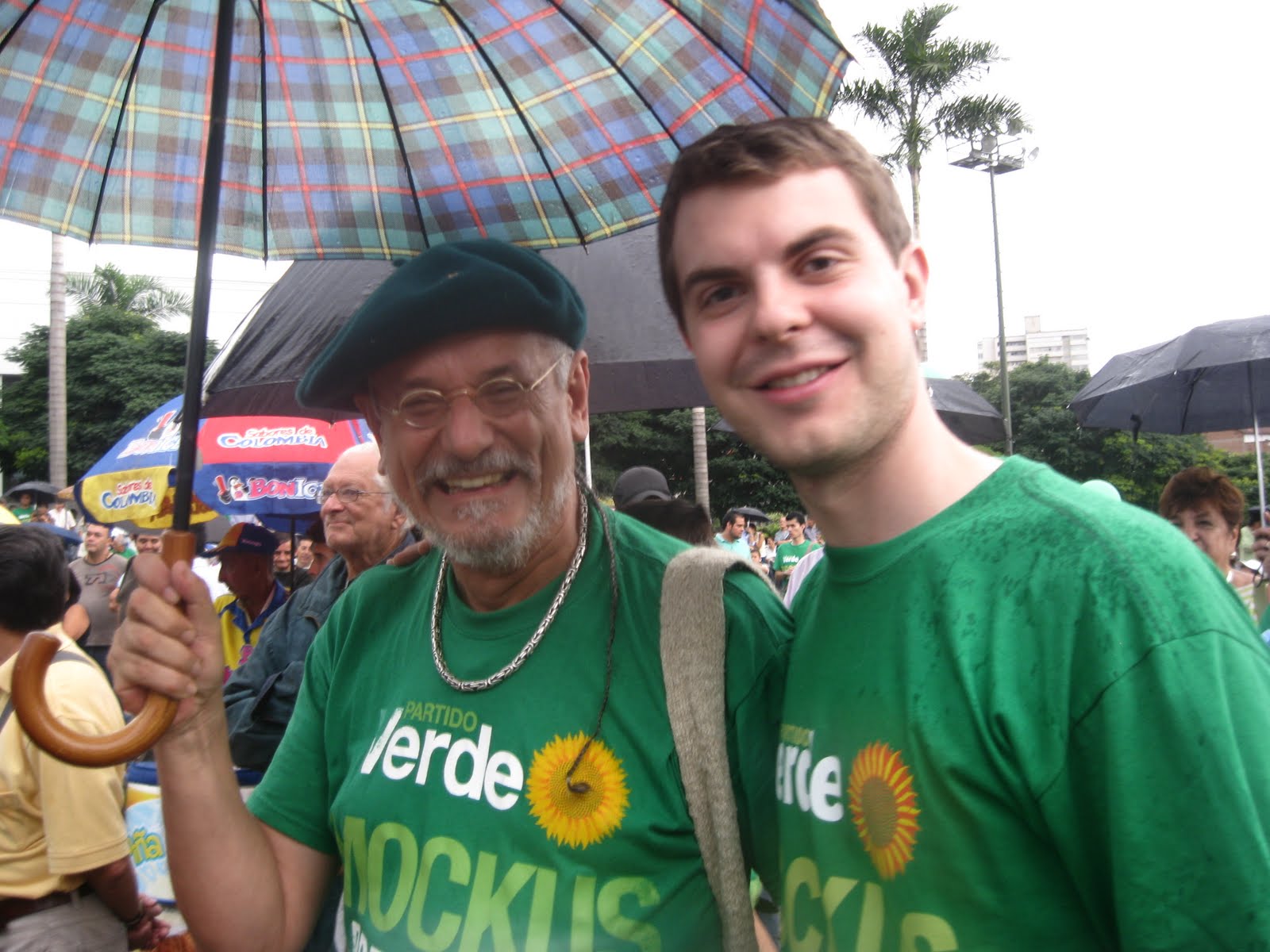
Today was a disappointing day for Mockus supporters. Although there is another election June 20th, and although Mockus did make it to the top two, and despite the fact that he could, in fact, still become president, he received a much smaller percentage of the vote than anyone predicted. Less than 22%, in fact. And Santos... well, he took around 46% of the vote.
I'm very disappointed because it is fairly unlikely that Mockus will win the next election. The next highest candidate, Vargas, who took around 10% of the vote, is a conservative, so that means all those votes will go to Santos. Sanin is also conservative--the only votes Mockus will take are those of Pardo (Liberal) and Petro (Democratic Poll).
I'm sure Mockus and his fellow Greens are both surprised and slightly devastated by the results, as I am. The polls consistently gave Mockus around 32% of the vote during the weeks leading up to this election, and I don't think anyone expected Santos to get such a high percentage during the first round of voting
My guess is that the polls did not accurately represent all the geographic regions of Colombia. Also, I think a lot of people came out of hiding to vote for Santos out of fear (secretly, many Colombians are still worried that without Uribe the country will return to the dangerous chaos of the past). I also think Santos did some dirty campaigning in the last month--for example, there is a Party of the U billboard in downtown Pereira that says "En Colombia, nosotros decidemos los Colombianos", which essentially means "In Colombia, we choose Colombians." It's a jab at Mockus's background... his parents are Lithuanian, but he was born here. Also, I'm not putting Santos above paying voters or altering the vote, as that is sadly a fairly common practice here. (Another billboard it town encourages people to vote for what they believe and to not let anyone buy their vote.) I'm not saying he did, but it has happened before.
Anyway. I'm not happy, but at least Mockus made it into the top two. There is still a chance he could win, and even if he doesn't, the Green Party has established a firm base of supporters here, and hopefully it will continue to grow.
Above: The crowd that gathered to see Mockus at Plaza Victoria. Warren and I are both in this photo--see if you can find us!
I never meant for my blog to get so political, and so I apologize if I am alienating any of you. I'm going to stop posting about the campaign until the actual election, but the campaign rally was not just about politics for me, it was also a cultural experience. I was able to meet up with fellow teachers from LPV and shout in Spanish. I waited with everyone for 2 1/2 hours (Mockus was 2 hours late!) and understood the frustration and the anticipation. I memorized the words to Mockus's campaign song because they played it so many times (he was really late, even by Colombian standards). It is not an experience I will forget. Despite myself, I understood a great deal of what Mockus said (which means I understand SPANISH!), and that meant more for me personally than being part of a political rally.
I'm not going to write much more, but I do want to include one anecdote from the rally. At one point, Mockus had three volunteers come on stage. He had them line up, facing each other. Then, he did that "trust" building exercise where the person in the middle falls back, and then forward, trusting the other two people to catch her. Each volunteer did it a few times, and then MOCKUS did it, too. He stood there and caught one of the volunteers, and then he also let himself be caught.
The reason I like Mockus is because he is a teacher. He is an academic. I relate to this man in many ways, because I am also a teacher. He truly values education, and I know he will put a great deal of effort into making education a priority in Colombia. He also wants to teach people to be better citizens, and he places a great deal of importance on culture. The thing is, his approach is totally different than most politicians. He doesn't just stand up and give a memorized speech (in fact, it felt like he was just winging his speech). He lectures. He gives demonstrations. He uses examples. The man is a teacher, and it permeates his style as a politician.
Anyway, that's all. I won't get all political on you again for a few weeks, I promise.
Warren and Jose/Flaco (the religion teacher).
MeryLu (a teacher at school) and me before Mockus arrived.
Symbols of his campaign (from Mockus's own website)
The pencil that represents his emphasis on education, legality, and culture. One of our favorite lines from his speech was this: "The future of Colombia will be written with a pencil, not with blood."
Thanks for reading. Just in case you like politics, be sure to read Warren's blog, Crashing the Political Party. Warren's so cool he saw President Uribe and Antanus Mockus in the same day. Be jealous. I didn't see Uribe, just his motorcade!
Today Warren and I went to a campaign rally for Antanus Mockus. We also saw Enrique Penalosa and Garzon. I'm going to write about the experience in uno momento in a different post, but I didn't want it to be too long with pictures and everything else. So, here are a few of my favorite photos!
When we arrived. La vida es sagrada: Life is sacred. His main message tonight was that every life in Colombia is important and we need to value every person and protect every person. It was refreshing, but also made me sad that a message like that even needed to be spread.
Thumbs up, like Mockus. Notice the Mockus bracelet on the hand to the left.
Mockus and his team arrived very late (almost 2 hours!), but it was worth it!
"The next chapter of Colombia will be written with pencils, not blood." (Regarding his push towards education.)
It was a lot of fun to be part of this event. More info in the next post.
With less than 4 weeks until the first round of the presidential election, things in Colombia are getting much more interesting. Mockus's popularity has been skyrocketing lately, and, much to his surprise and despair, Santos's popularity just keeps falling in the polls. It's almost inevitable that Mockus and Santos will face off in the 2nd election, but politics in Colombia tend to be dirty, and elections are not always won fairly, so I'm not ready to guarantee a win for Mockus. (Even if I desperately want to!)
It seems that, in Pereira at least, Mockus is the only candidate anyone is supporting these days. A few billboards around town advertise other candidates, but the real indicators are the campaign signs hung in the windows of apartments across town. I have only seen posters for Mockus or Partido Verde--not a single one for Santos. The administration at LPV are wearing Mockus bracelets, the students are selling Partido Verde t-shirts, and the other teachers are proudly sporting Mockus logos on everything from laptops to backpacks. When I hung up a Mockus poster on my desk, my students cheered.
During lunch on Monday Warren and I talked to the school psychologist, and we asked her why she personally liked Mockus. She told us that it was because he isn't a politician, he is an academic and a teacher. She also explained that he demonstrated he can make a difference when he was mayor of Bogota, and that he can help make the future better for Colombians. I'ts a lovely summary of exactly why I support Mockus, too.
So far, my favorite sign of support was a car we saw over the weekend. It had 2 posters hung in the windows, a Mockus sticker on the bumper, another Partido Verde sticker on the windshield, and a fake sunflower (the symbol of the Colombian Green Party) bobbing up and down in the passenger window. Warren and I almost started cheering for it!
Of course, this election is not the only one in the world: today is the British election, which is outlined well on Warren's blog and I just got the first email regarding the gubernatorial race in Illinois. In case you can vote in Illinois and you are a Green Party supporter, make sure you check out Rich Whitney! It's time Illinois gets a decent governor instead of the crazies we've had to put up with in the past!
In 2008, I was addicted to news about the presidential elections in the United States, but I was equally depressed by the media. If you don't know me very well, it's probably time for me to confess something: I have some very strong political views. In the 2008 elections, I was horrified that a man straight out of the Chicago political machine with almost no real experience was so incredibly popular. I was horrified by the Republican party, too. I voted Green. Warren voted for Nader. We felt like political outcasts because we know voting for 3rd parties is more of a protest against current politics than an actual vote. For someone like me, who really wants to part of the political conversation, shouting about the Green party candidate and driving around with a bilingual bumper sticker on my car (Green Party/Partido Verde) made me feel like I was making a statement, but everyone just tuned me out and campaigned for Obama.
Politics in the U.S. are nasty and unfair. We are one of the few Western countries in the world with only 2 viable parties. Everybody else has at least one viable third party, except Australia, Spain, and Portugal. There's no way two parties who have been around for over a century represent what people want. The Democrats and Republicans only represent the big business and unions that give them the donations they need to silence other candidates during campaigns.
Why am I talking about politics on my blog while writing from Colombia?
Colombia has a presidential election this year. The first election is May 30, so we're getting really close and the race is starting to get exciting. However, the fact that this is an exciting election surprises everyone, especially Colombians.
First of all, the current president, President Uribe, was generally expected to win this election 5 months ago. When we first arrived, it was widely believed that he would be granted permission to run for a third term by the Colombian Supreme Court. Current law prohibits presidents from having a 3rd term, but that seemed like a small obstacle because in the 2006 elections Colombia changed a law that allowed presidents only 1 term so that Uribe could run for a 2nd term. On the 26th of February, the Colombian Supreme Court decided Uribe would not be granted permission to run for a 3rd term.
For "uribistas", this was disappointing, but they simply turned to Uribe's Defense Minister, Juan Manuel Santos. Santos, who originally was running as a place-holder candidate for Uribe in the Party of the U(ribe/Unity), expected little competition. No one in Colombia was excited about Santos, and the general attitude at first was that people were disappointed that Uribe would not run again.
Between February and April, a radical shift in politics has shaken Colombia awake. In August 2009, three former mayors of Bogotá rebuilt the Green Party in Colombia. The mayors, Penalosa, Mockus, and Garzon, were famous for totally changing Bogota into a clean and safer city. (For a fantastic documentary about this, check out my link below.) After a primary it was decided that Mockus would run for president this year. He has been campaigning for just over a month, but after choosing Sergio Fajardo, a former mayor of Medellin, he is consistently ranked at least 2nd in the polls. In fact, according to a poll on Thursday, he is winning.
Being in Colombia for this election is incredible. In just a few weeks, people have begun to see a different kind of future for Colombia. One without "politics as usual," which, in Colombia, means widespread corruption, widespread spying on civilians (wiretapping EU meetings? Just a daily occurrence at DAS, apparently), and, particularly horrifying, false positives. I hated it when Obama promised that his term would be different, because even if he succeeded at fulfilling every single proposal he has, any change in the way we do politics in the States was never part of his agenda. Mockus, however, is not just promising change. He has proven he has the ability to create change in his terms as mayor. (For example, check out this article about Bogotá, and how it beat out all American cities and came in third against Amsterdam and Copenhagen--for cyclists!)
More importantly, Mockus is not part of the standard political structure in Colombia. Santos' great-uncle was president. Mockus' mother is a sculptor from Lithuania. He has a PhD in mathematics, was a professor at Harvard, was the chancellor at Universidad Nacional, is a philosopher, and has Parkinson's disease (in its early stages). He speaks English, Spanish, French, and Lithuanian. He has a beard. This man is not your typical Colombian.
His previous policies as the mayor of Bogotá and chancellor of Universidad Nacional were controversial but effective. For example, he mooned an auditorium of rioting students because they would not let him speak. He hired mimes to humiliate people who broke traffic laws because fines were ineffective. He closed all the bars at 1 a.m. because of the city's crime rates. He called that law the Carrot Law--which, in American slang, would translate to the Goody-Goody Law. He continued Penalosa's work during his own second term, expanding the TransMilenio bus system that works like a metro and has been lauded by environmentalists worldwide. As mayor, he reduced the crime rate and murder rate, reduced traffic and automobile accidents, and attempted to give Bogota a moral conscience. He even dressed like a superhero (tights and all) and called himself "Super Citizen." Basically, Obama can only dream about being as cool as this guy.
His campaign should be making headlines worldwide. If he wins, he will be the first Green Party candidate to become president of any country, any where. In a world facing economic turmoil and increasing environmental problems, his possible presidency seems like a sign of things to come. Especially in Colombia.
If I spoke better Spanish, I would be out on the streets, campaigning daily for Mockus. I want to vote for Mockus, I want to be part of this possibility. It is rare that I find a political candidate I can fully support. Mockus is a bit radical in his approach, but not in his ideas. His campaign slogan is this: "Con educación todo se puede" - With education, everything is possible. I love this man.
With the first election approaching quickly, Mockus has gone from being part of the "Three Stooges" to being the primary opponent to Santos. Because Colombia has two elections, this is especially significant. In the first election, on May 30, people vote for whomever they want. Since there are over 12 parties in Colombia, it is rare for a candidate to get over 50% of the vote in the first election. Therefore, Colombia holds a second election less than a month later, and only the top two candidates in the first election are allowed to run. This gives everyone a say in who the next president will be, twice. At this point, it seems very likely that the top two candidates will be Santos and Mockus. Of course, if one candidate can get 50%+1 vote, that candidate will win and a second election won't be necessary. Mockus recently suggested that if he wins the first election, the money saved from only needing one election could build 20 schools.
Like I said, I love this man.
For more information, check out all my links (Grandma, click on anything that is blue and it will lead you to a new webpage) or watch the documentary called Bogotá Cambio, which is available on YouTube. (I've embedded the first part of seven below.)