If you are fluent or close in Spanish, you can probably quickly learn how to ask if something has cheese, eggs, meat, milk, or butter in it (queso, huevos, carne/pollo/cerdo, leche, mantequilla), but Colombian cuisine necessitates asking about these as well:
1. Sustancia. (It's like chicken broth.) It's in almost EVERY soup in Colombia, with lentils being the only almost always safe one.
2. Crema. (cream) It appears in everything from potatoes to corn to dessert.
3. Mayonesa (mayonaise) is a common addition to veggies and salads.
4. Grasa (fat), which is basically added to all bean dishes that are specifically prepared vegetarian. Especially pork fat. Even if there is no meat in your bowl, there is almost always meat fat in the beans!
5. Gelatin is everywhere, appearing in candy, snacks, and many other things.
6. Leche en polvo, or powdered milk, also appears in many desserts and snacks.
7. A lot of bread, especially from bakeries, has eggs, butter, or milk. Even though they look enticing, the famous Colombian bunelos are made with cheese and butter, so either avoid them or be prepared for a stomach ache.
So, what should you avoid? Well, if you don't speak much Spanish, I would say that it's best to avoid breads that you can't read an ingredient list for, all other baked goods, most candy, almost all soups, and a lot of the side dishes. Obviously, avoid meat and cheese dishes. Also, beware, a lot of the food sold on the street can make you sick, so it's best to buy it and make it yourself or buy it from/have it made by someone you know is practicing good hygiene. Rice is generally safe, and other safe foods are listed in this blog post.
Showing posts with label Colombia. Show all posts
Showing posts with label Colombia. Show all posts
Tuesday, November 23, 2010


Vegan Packing List & Grocery Shopping List for Colombia
Things to pack:
If you are coming to Colombia for a long time, will have access to a kitchen, and can bring food with you, these are my suggestions...
1. Ground flax seeds. Use as egg replacer.
2. Ener-G Egg replacer
3. Real Vanilla (okay, everyone should bring this...)
4. Protein bars or powder, although you can find both here
5. Vital Wheat Gluten flour. Use to make seitan, chickpea cutlets, vegan sausage, etc.
6. Peanut butter or other nut butters, and a lot of it!
7. Any of your favorite vegan "crave" foods that might be difficult to find. For me, it was dried cranberries.
8. Spices! Chili powder, fennel, red pepper flakes... these tend to be hard to find.
Grocery locations:
These places are where I find most of my groceries in Pereira...
1. Tofu-Exito, vegetarian restaurants with weird hours downtown
2. Soymilk- Silk at Exito, Ades at all other stores
3. Protein powder- Soy Plus, all well-stocked supermarkets
4. Veggies and Produce- the best variety is usually found at La 14. Carrefour is the cheapest but runs out faster.
5. Organic amazing fresh basil-Carrefour
6. Canned chickpeas-Exito, La 14
7. Fat free refried Old El Paso pinto beans: Exito
8. Spices: La 14
9. Fresh bread: bakeries at Carrefour and Exito
10. Lee Kum Kee Terriyaki Sauce: La 14 and Carrefour
11. Low sodium, high quality soy sauce: Carrefour
12. Other vegan canned beans: La 14
13. Santander chocolate: La 14, Exito, sometimes Carrefour
14. Wine: Alkosto (cheap)
15. Peanut butter--Carrefour, but it is massively and prohibitively expensive to be a regular grocery item
For good beer, only Carrefour has European brews. Warren wanted everyone to know...
If you are coming to Colombia for a long time, will have access to a kitchen, and can bring food with you, these are my suggestions...
1. Ground flax seeds. Use as egg replacer.
2. Ener-G Egg replacer
3. Real Vanilla (okay, everyone should bring this...)
4. Protein bars or powder, although you can find both here
5. Vital Wheat Gluten flour. Use to make seitan, chickpea cutlets, vegan sausage, etc.
6. Peanut butter or other nut butters, and a lot of it!
7. Any of your favorite vegan "crave" foods that might be difficult to find. For me, it was dried cranberries.
8. Spices! Chili powder, fennel, red pepper flakes... these tend to be hard to find.
Grocery locations:
These places are where I find most of my groceries in Pereira...
1. Tofu-Exito, vegetarian restaurants with weird hours downtown
2. Soymilk- Silk at Exito, Ades at all other stores
3. Protein powder- Soy Plus, all well-stocked supermarkets
4. Veggies and Produce- the best variety is usually found at La 14. Carrefour is the cheapest but runs out faster.
5. Organic amazing fresh basil-Carrefour
6. Canned chickpeas-Exito, La 14
7. Fat free refried Old El Paso pinto beans: Exito
8. Spices: La 14
9. Fresh bread: bakeries at Carrefour and Exito
10. Lee Kum Kee Terriyaki Sauce: La 14 and Carrefour
11. Low sodium, high quality soy sauce: Carrefour
12. Other vegan canned beans: La 14
13. Santander chocolate: La 14, Exito, sometimes Carrefour
14. Wine: Alkosto (cheap)
15. Peanut butter--Carrefour, but it is massively and prohibitively expensive to be a regular grocery item
For good beer, only Carrefour has European brews. Warren wanted everyone to know...
Thursday, November 11, 2010
Things that are basically always vegan in Colombia, unless otherwise noted.
Vegans can almost always eat or drink:
1. Juice (jugo) except that you nearly always need to specify jugo con agua, because a lot of places like to put milk in it, making it jugo con leche. I recommend lulo, mora, naranja, and maracuya.
2. Lentils (lentejas). Lentil soup is naturally vegan in Colombia, except in resaurants and homes that like to make things fancy and add chorizo. So, just ask if you are in doubt: Tiene carne o pollo o chorizo o sustancia? If they say no, you´re good to go.
3. Fruits and veggies, although I generally don´t think it is a great idea to eat any of the fruit sold at street vendors, solely because most of them do not wear gloves or wash their hands and I have gotten sick too many times.
4. Some crackers sold in Supermarkets. Most Dux and Club Crackers are okay. Almost no granola bars are. Read the ingredients. Avoid anything with huevos, leche, mantequilla, queso or gelatin.
5. Santander 70% dark chocolate. This is very important.
6. Rice (sometimes it has butter, which is mantequilla, or milk, which is leche.) I like coconut rice best, which is arroz de coco.
7. Salads without dressing (or only oil, which is aceite, and vinegar, which is vinagre).
8. Most versions of plantains, including platano maduro, patacon, and tostones. When ordering a giant patacon (like in Salento), the best vegan topping is a mixture of pina and pimenton, but it goes by different names. Just ask for it. Platano maduro is sometimes served with butter or cheese, so just ask if it has queso. (Tiene queso o mantequilla?) Tostones should be fine no matter what, but avoid eating most Colombian guacamole, because they put mayonaise in it (generally speaking, it is okay in most Mexican restaurants though.)
9. Canned beans in the supermarket that are ONLY beans... basically just garbanzos. Always read the ingredients, and avoid anything called manteca de cerdo or other meat.
10. Fruit popsicles at Mimo´s.
11. The refried beans at many Mexican restaurants.
12. Falafel at most Arabic resaurants.
13. Things you cook yourself.
1. Juice (jugo) except that you nearly always need to specify jugo con agua, because a lot of places like to put milk in it, making it jugo con leche. I recommend lulo, mora, naranja, and maracuya.
2. Lentils (lentejas). Lentil soup is naturally vegan in Colombia, except in resaurants and homes that like to make things fancy and add chorizo. So, just ask if you are in doubt: Tiene carne o pollo o chorizo o sustancia? If they say no, you´re good to go.
3. Fruits and veggies, although I generally don´t think it is a great idea to eat any of the fruit sold at street vendors, solely because most of them do not wear gloves or wash their hands and I have gotten sick too many times.
4. Some crackers sold in Supermarkets. Most Dux and Club Crackers are okay. Almost no granola bars are. Read the ingredients. Avoid anything with huevos, leche, mantequilla, queso or gelatin.
5. Santander 70% dark chocolate. This is very important.
6. Rice (sometimes it has butter, which is mantequilla, or milk, which is leche.) I like coconut rice best, which is arroz de coco.
7. Salads without dressing (or only oil, which is aceite, and vinegar, which is vinagre).
8. Most versions of plantains, including platano maduro, patacon, and tostones. When ordering a giant patacon (like in Salento), the best vegan topping is a mixture of pina and pimenton, but it goes by different names. Just ask for it. Platano maduro is sometimes served with butter or cheese, so just ask if it has queso. (Tiene queso o mantequilla?) Tostones should be fine no matter what, but avoid eating most Colombian guacamole, because they put mayonaise in it (generally speaking, it is okay in most Mexican restaurants though.)
9. Canned beans in the supermarket that are ONLY beans... basically just garbanzos. Always read the ingredients, and avoid anything called manteca de cerdo or other meat.
10. Fruit popsicles at Mimo´s.
11. The refried beans at many Mexican restaurants.
12. Falafel at most Arabic resaurants.
13. Things you cook yourself.
Tuesday, November 9, 2010
@ Home Sick: Medicine in Colombia
I'm home sick today, and so I thought I'd give you a short guide and some tips to medicine in Colombia.
1. My number one tip is to know the scientific or medical name of all the medications you would normally use at home (look on the ingredients list). That way, words like acetaminofen will be easy to recognize as the Spanish equivalent to acetaminophen, which is Tylenol. Usually you can look these up online. A good thing to try before heading to a pharmacy (drogueria) is to look up the ingredients in the medication you would normally take and then try to translate them into Spanish.
2. My number two tip is learning enough Spanish (even right before you use it) to explain your symptoms. Try to be specific. If you have a stomach ache, be able to describe exact symptoms and where it is. That will help a pharmacist locate the correct medication. It might not always be as effective as you hope, but it's better than nothing.
3. Don't assume Colombian medications, or any international medications, aren't as good as American ones. When I lived in Denmark I got a horrible cold and desperately needed Sudafed, but they didn't sell it or anything like it. Instead the pharmacist gave me a medicated nasal spray. It worked so much better than Sudafed that I miss that stuff! In June I got a horrible cold in Colombia, and they gave me a shot in my butt, which is a common treatment here. I thought it was odd, but I felt better in just a few hours.
4. When in doubt, go to the doctor (or have one come to you), have him or her figure out what you need, and ask him/her to call the pharmacy for you. Most pharmacies will deliver, and a great deal are even 24 hours.
5. Finally, the easiest tip of all is to bring medication with you from home. Some things are easy to find here (Colombian Tylenol), but other things you'll probably never find. If there's something you can't survive without, or simply always depend on, bring it with you. Make sure it's allowed on planes and you can bring it into the country, of course. Also, if you are bringing prescription medication, definitely bring the prescription with you!
Okay, here's a simple guide to get you started...
1. You can find generic acetaminofen (Tylenol( at any supermarket. The brand name here for it is Dolex, and just like Tylenol, Dolex makes versions for flu (gripa) and colds/sinuses (sinus).
2. Ibuprofen is almost exactly the same word--Ibuprofeno, and is also available everywhere. Don't take it if you are having stomach problems. Ibuprofen needs to be taken with food--take Tylenol when you have a stomach issue.
3. Smecta is the closest thing Colombia has to Pepto-Bismol. It is a powder you buy in packets and mix into water. It has a chalky-orange flavor. Sometimes it takes a few tries for it to work--you are supposed to drink two glasses every eight hours. If you get sick, try this. Colombians might recommend it, but I do not recommend Buscapina. It's a muscle relaxer. I do recommend Pedialyte or Gatorade(they've got the same stuff here) if you have traveler's diarrhea.
4. For congestion problems, it is possible to get oseudoephedrine (Sudafed), but it is hard to find. The only time I've managed to get it was when a SER doctor ordered it for me. Not all pharmacies carry it, either. If you can find it, the medication I got with it is called "Antiss-D". Instead, you can try a few different medications. Descongel Gripa and Sinutab both have Phenylephrine, which is the ingredient in most over-the-counter Sudafed now. It's not as effective, but it will certainly help.
5. Although weird, for sunburn relief, you can try milk of magnesia (leche de magnesia or crema de magnesia), or you could just buy an Aloe leaf at the supermarket, cut it up, and lay it on your skin. I've done both. They work well and are very cheap.
6. Mosquitoes bites here are always treated with alcohol. I'm not sure if that's because it helps dry the bite out or if it is because they are worried about diseases that mosquitoes carry, but it works. Just give it a few hours and don't scratch. Alcohol goes by the same word here.
7. Mosquito repellent is called "repelente de insectos". You can find all sorts of stuff here. I like the roll-on sticks, but we also used a brand called Bacterion, and it was just fine.
8. Contact solution in Colombia... this one is easy! Use Wasser. They have one called Multi 20/20 that you can use for hard and rigid gas permeable contacts (gas permeables) and they have another one called Multi Solution that works for soft contacts. The word for contacts is lentes de contacto. I also bought a contact lens here that I am definitely happy with, so don't be afraid of them if you need them!
Women only:
1. If it matters, tampons with applicators aren't super easy to find, and I'd definitely recommend going for the American brands if you find them. I don't know why, but they just aren't super popular here. They are also EXPENSIVE, so bring generic brand ones (like Target) from home if you can plan for it.
2. I've never found anything like Midol here, but when I'm desperate I just take Tylenol and each chocolate or have something else with caffeine, which is basically what Midol does. You can also do some specific yoga positions when you have cramps/bloating. Buscapina advertises that it helps menstrual cramp pain. It's a muscle relaxer. I've taken it for other things and don't recommend it.
3. Birth control is available over-the-counter here. Just go to the store and ask for it. Mini-Pill seems to be popular. It's a low-dose one. There are other types available, check the ProFamilia website if you have questions. It's helpful. If you don't speak Spanish, don't whine, just translate it using an online translator.
1. My number one tip is to know the scientific or medical name of all the medications you would normally use at home (look on the ingredients list). That way, words like acetaminofen will be easy to recognize as the Spanish equivalent to acetaminophen, which is Tylenol. Usually you can look these up online. A good thing to try before heading to a pharmacy (drogueria) is to look up the ingredients in the medication you would normally take and then try to translate them into Spanish.
2. My number two tip is learning enough Spanish (even right before you use it) to explain your symptoms. Try to be specific. If you have a stomach ache, be able to describe exact symptoms and where it is. That will help a pharmacist locate the correct medication. It might not always be as effective as you hope, but it's better than nothing.
3. Don't assume Colombian medications, or any international medications, aren't as good as American ones. When I lived in Denmark I got a horrible cold and desperately needed Sudafed, but they didn't sell it or anything like it. Instead the pharmacist gave me a medicated nasal spray. It worked so much better than Sudafed that I miss that stuff! In June I got a horrible cold in Colombia, and they gave me a shot in my butt, which is a common treatment here. I thought it was odd, but I felt better in just a few hours.
4. When in doubt, go to the doctor (or have one come to you), have him or her figure out what you need, and ask him/her to call the pharmacy for you. Most pharmacies will deliver, and a great deal are even 24 hours.
5. Finally, the easiest tip of all is to bring medication with you from home. Some things are easy to find here (Colombian Tylenol), but other things you'll probably never find. If there's something you can't survive without, or simply always depend on, bring it with you. Make sure it's allowed on planes and you can bring it into the country, of course. Also, if you are bringing prescription medication, definitely bring the prescription with you!
Okay, here's a simple guide to get you started...
1. You can find generic acetaminofen (Tylenol( at any supermarket. The brand name here for it is Dolex, and just like Tylenol, Dolex makes versions for flu (gripa) and colds/sinuses (sinus).
2. Ibuprofen is almost exactly the same word--Ibuprofeno, and is also available everywhere. Don't take it if you are having stomach problems. Ibuprofen needs to be taken with food--take Tylenol when you have a stomach issue.
3. Smecta is the closest thing Colombia has to Pepto-Bismol. It is a powder you buy in packets and mix into water. It has a chalky-orange flavor. Sometimes it takes a few tries for it to work--you are supposed to drink two glasses every eight hours. If you get sick, try this. Colombians might recommend it, but I do not recommend Buscapina. It's a muscle relaxer. I do recommend Pedialyte or Gatorade(they've got the same stuff here) if you have traveler's diarrhea.
4. For congestion problems, it is possible to get oseudoephedrine (Sudafed), but it is hard to find. The only time I've managed to get it was when a SER doctor ordered it for me. Not all pharmacies carry it, either. If you can find it, the medication I got with it is called "Antiss-D". Instead, you can try a few different medications. Descongel Gripa and Sinutab both have Phenylephrine, which is the ingredient in most over-the-counter Sudafed now. It's not as effective, but it will certainly help.
5. Although weird, for sunburn relief, you can try milk of magnesia (leche de magnesia or crema de magnesia), or you could just buy an Aloe leaf at the supermarket, cut it up, and lay it on your skin. I've done both. They work well and are very cheap.
6. Mosquitoes bites here are always treated with alcohol. I'm not sure if that's because it helps dry the bite out or if it is because they are worried about diseases that mosquitoes carry, but it works. Just give it a few hours and don't scratch. Alcohol goes by the same word here.
7. Mosquito repellent is called "repelente de insectos". You can find all sorts of stuff here. I like the roll-on sticks, but we also used a brand called Bacterion, and it was just fine.
8. Contact solution in Colombia... this one is easy! Use Wasser. They have one called Multi 20/20 that you can use for hard and rigid gas permeable contacts (gas permeables) and they have another one called Multi Solution that works for soft contacts. The word for contacts is lentes de contacto. I also bought a contact lens here that I am definitely happy with, so don't be afraid of them if you need them!
Women only:
1. If it matters, tampons with applicators aren't super easy to find, and I'd definitely recommend going for the American brands if you find them. I don't know why, but they just aren't super popular here. They are also EXPENSIVE, so bring generic brand ones (like Target) from home if you can plan for it.
2. I've never found anything like Midol here, but when I'm desperate I just take Tylenol and each chocolate or have something else with caffeine, which is basically what Midol does. You can also do some specific yoga positions when you have cramps/bloating. Buscapina advertises that it helps menstrual cramp pain. It's a muscle relaxer. I've taken it for other things and don't recommend it.
3. Birth control is available over-the-counter here. Just go to the store and ask for it. Mini-Pill seems to be popular. It's a low-dose one. There are other types available, check the ProFamilia website if you have questions. It's helpful. If you don't speak Spanish, don't whine, just translate it using an online translator.
Monday, November 8, 2010
Vegan Chocolate Cake (easily made in Colombia)

I promised a post, and I'm going to deliver! With photos!
This is a very moist and fairly chocolate-y cake, especially considering how amazingly accessible the ingredients are. I imagine it would be easy to duplicate this cake almost anywhere in the world. Well, anywhere that has an oven. (Although, since the batter is vegan, you could just eat the raw cake batter. Mmmmm.) The best thing about this cake is that it is SUPER easy and contains really normal ingredients, so it is a great cake to make any time, even if you aren't vegan. Also, it avoids most allergies (except gluten!), so it's pretty friendly. It's low fat if you use the orange marmalade because you can use less oil... Plus, it's delicious. The texture is somewhat like a light brownie.

Essential equipment for vegan baking in Colombia:
 a measuring cup
measuring spoons
whisk
2 mixing bowls
heaving spoon (plastic or wood) to do heaving mixing
Although it isn't essential, I highly recommend a spring-form pan for this cake. Just like a cheesecake, it's very moist and dense, so it would fall apart if you tried to remove it from the pan, and just like a cheesecake, it is prettier when you can see the sides. Obviously, it is up to you, but if you want a 12 inch spring-form pan, I know they sell them at La 14.

Moist Vegan Chocolate Cake, Egg-free, Dairy-free
Here's the basic recipe:
2 cups flour (harina de trigo)
1 cup cocoa (cocoa en polva--my favorite brand is Luker)
1 teaspoon salt (sal, I like sea salt best. It's called sal marina)
2 teaspoons baking soda (bicarbonato)
1 cup of white sugar* (azucar blanco)
1 cup of brown sugar** (azucar moreno)
2 teaspoons white vinegar (vinegre blanco)
2 teaspoons (at least) of vanilla (again, I can only find the fake stuff here, but it's called vainilla)
1 3/4 cups soy milk (leche de soya. I recently discovered that Exito marked down the price of Silk, and Silk changed its packaging so it is in Spanish on one side. Check near the cereal aisle. I prefer Silk Unsweetened Natural.) You can sub water for this if absolutely necessary. I wouldn't. You could also sub orange juice. That might be a bit better.
1/4 (maybe a bit more) of juice from fresh oranges
2 tablespoons of canola oil
1/2 cup orange marmalade (mermelade de naranja, my favorite brand is La Constencia)
3 tablespoons (or more!!) of shaved unsweetened table chocolate. I used about 2 squares of Luker.
*I think it is vegan here because the kind I buy is very unprocessed, but using only brown sugar, which is actually turbindo sugar in Colombia, would not hurt a thing.
** If you like a very sweet cake, go ahead and use 2 cups of sugar. If you like a slightly more bitter cake, I would definitely recommend cutting down the sugar to about 1 1/2 cups, maybe even a tad bit less.
Directions:
1. Add flour, cocoa, salt, and baking soda to a mixing bowl. Mix thoroughly with a whisk to get rid of clumps OR sift.
2. In a measuring cup, measure the soy milk. Add the orange juice to the soy milk and stir. Dump in another mixing bowl (not the one with the dry ingredients!).
3. Add the oil, vanilla, vinegar, and canola oil to the soy milk mixture. Then add the sugar. Whisk until it is well-blended. Then, add the orange marmalade. Stir.
4. Add the wet ingredients to the dry ones. It should bubble a bit because of the chemical reaction between the baking soda and vinegar. Stir to incorporate, and then whisk until completely blended.
5. Add Luker shavings. Stir well.
6. Pour batter into a greased and floured baking sheet (9 x 13, 2 small loaf pans, or a 12 inch round pan).
10. Bake at 350 degrees F. Depending on the size of your oven and the size of your pan, this could take anywhere from 20 minutes to 45. Check on it often. The top should set (it shouldn't wiggle if the pan is shaken), and a toothpick should come out relatively clean (read: crumbs okay, raw batter not really) when inserted into the center.
11. Let it cool, and then top it with this quick icing:
 Melody's best icing:
1/2 cup cocoa powder
1/3 cup powdered sugar (you can make this, look up a recipe online, or buy it... azucar pulverizada)
1 teaspoon vanilla
1 tablespoon soy milk (may need more)
Sift cocoa powder and powdered sugar together. Stir well. Add vanilla and soy milk. Whisk. You might need to add more soy milk, but whisk really well before you do. It should be about the same consistency as liquid dish soap--easily pourable and spreadable. Pour it onto your cake and spread it with a knife. It will set quickly, so if you want to add toppings do it now. For this cake, I added coconut (coco) and Oreos, which are vegan if you eat white sugar. (They don't have Newman O's in Colombia.)
It makes a cute birthday cake!

Variations:
Orange-Chocolate: You can make this extra orange-y by adding shaved orange peel to the batter and using more orange juice to replace some of the soy milk. You can also use orange juice instead of soy milk in the icing, and then you can top it with orange peel.
Chocolate-coconut: Replace up to one cup of the soy milk with coconut milk, or simply reduce the vanilla to 1 teaspoon and add 2 teaspoons of coconut extract. Sprinkle with coconut.
Chocolate-strawberry: Use strawberry (fresa) jam instead of orange marmalade.
Plain old chocolate: Use 2/3 cup canola oil, get rid of the 2 tablespoons and don't use orange marmalade. Add another tablespoon of shaved chocolate to the batter, an extra 1/4 teaspoon salt, reduce sugar to 1 1/2 cups, and add an extra tablespoon of vanilla.
 I made this YESTERDAY, and between my friends, my masseuse, Warren, and me, almost half of it is gone!
Monday, October 18, 2010
Parque Nacional del Cafe, Montenegro, Colombia
 It's a long weekend here (today is one of those Catholic holidays), so on Saturday the "gringos" went to the one place everyone always tells us to go and the one place none of us had ever been: Parque Nacional del Cafe. I haven't mentioned it much before, but since the beginning of Term 3 there have been 5 American teachers at LPV (previously there were 3, me, Warren, and Ben, who teaches high school English). We very occasionally do activities as a group (bars, food, parties, etc.), and for whatever reason, we decided to tackle Parque del Cafe as a group of gringos instead of asking a Colombian friend to help us out.
What that means is that we took the wrong bus and probably spent too much money, but we also had a great time.
Parque Nacional del Cafe is literally a theme park dedicated to coffee and the coffee-growing spirit of Colombia. The rides are not exactly thrilling, but the landscape is beautiful and we saw an enjoyable "Show del Cafe" that featured traditional dances, music, and costumes. It was a good day and we had fun, especially after we returned to Pereira and ate at one of the only restaurants in PEI that I can recommend for vegans--Kilaba. (It's an Arabic restaurant across from Pepe Ganga on Circunvalar. Decent hummus and falafel.) Anyway, I've outlined my advice for Parque Nacional del Cafe below. Hope it's helpful!

1. To get there, DO NOT take the Expreso Alcala bus that says it goes directly to Parque del Cafe. It is a lie. It goes on the back roads to Montenegro, and then you need to take a bus, taxi, or Jeep Willys to get to Parque del Cafe. INSTEAD, take a bus to Armenia (there are a lot of express buses to Armenia from both Cali and Pereira). Once you arrive, you can arrange to take a Willys, taxi, or bus to Parque del Cafe. I imagine a bus is the cheapest way, but due to Expreso Alcala's false advertising, we went the wrong way there and took a Jeep Willys from Montenegro. The Jeep ride cost us 8,000 pesos total from Montenegro. A taxi was apparently 7,000, but we didn't fit in a taxi, and we didn't feel like finding a bus. A taxi TO Armenia from the park was 20,000 and a Jeep was 25,000.
On our first jeep:

2. Once you arrive, you have a lot of choices when it comes to buying a ticket. We had planned to do the "7 aventuras" ticket, but when we arrived our group decided to do the "multiple" ticket instead, which was more expensive but included everything. My advice is this: if you have all day, especially during the week, and also if you like horses, go for the multiple ticket. If you don't have all day (We had less than 6 hours) and you don't care if you ride the horses or not, go for "7 aventuras." Remember you will waste a lot of time standing in lines for the rides and/or shows. If you want to skip the rides and just walk around the park, you could definitely do that. It's also possible to pay for the various attractions when you do them.
3. What to do: Take the teleferico down to the main part of the park OR walk down the hill through the "Forests of Myths and Legends." Enjoy the rides but don't expect Six Flags roller coasters. Make sure you spend a substantial amount of time just wandering through the park, because it is quite beautiful. I think the park itself is much cooler than the rides. Also, make sure you see the "Show del Cafe." It's not exactly Broadway, but it was fun and I enjoyed it. The show is about an hour; make sure you are in line at least 30 minutes before the doors open. Apparently the museum is a bit lame; we didn't have time to go in so I can't personally attest to this. The teleferico and coffee fields below:
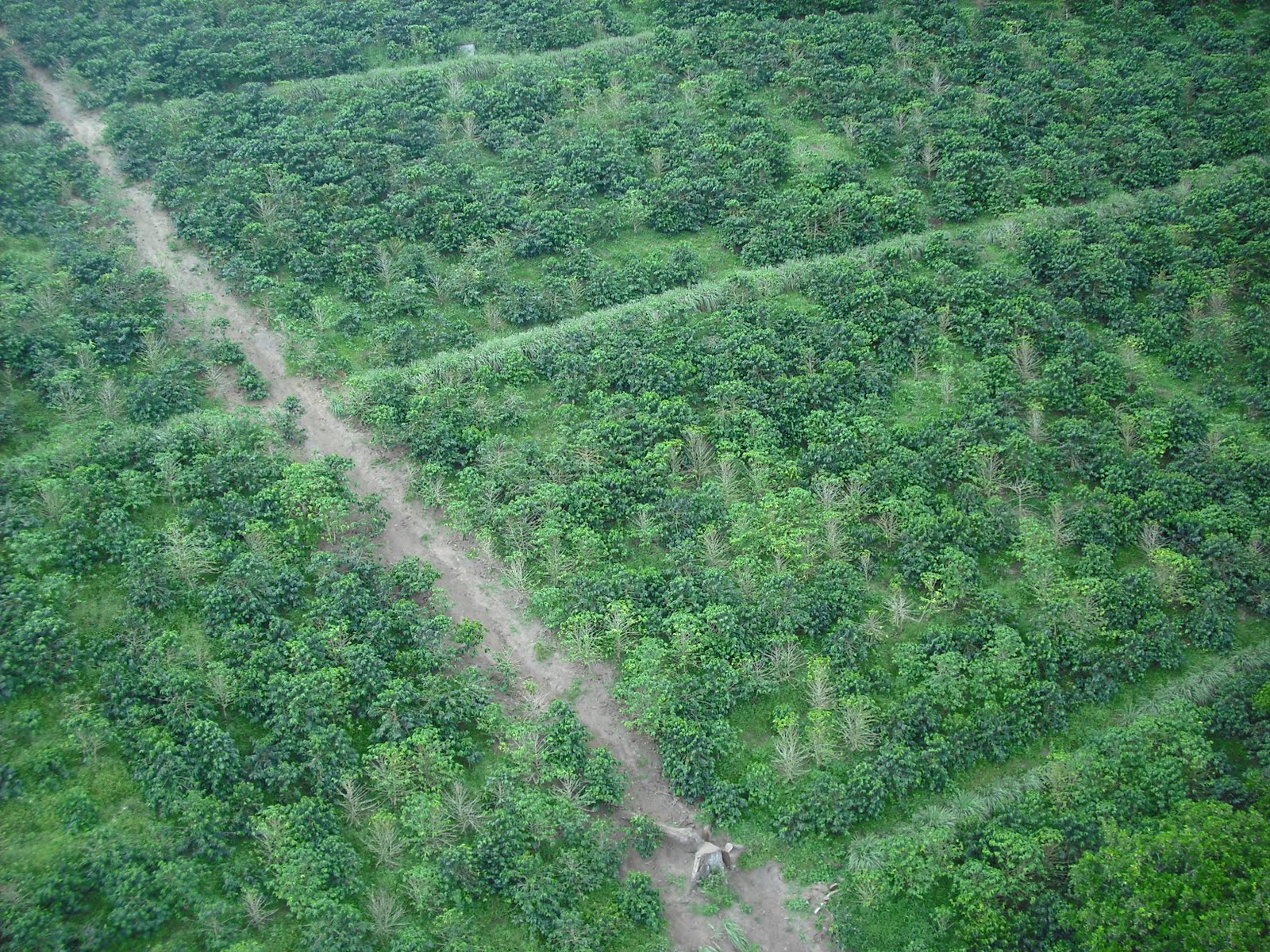

4. Food: There are restaurants outside of the park and inside the park. Snacks and drinks were not marked up inside the park, and you could bring small food items inside in a purse/backpack. Apparently the park serves good food, but all I had was juice, popcorn, and cotton candy. Those were all good though!
5. Leaving: To leave, we took a Willy to Armenia's bus terminal and then hopped onto a direct bus to Pereira. Definitely easy. The bus cost 7,700 pesos and the Jeep was 25,000 for 5 of us. A taxi would be cheaper (and warmer) but as I said before, we didn't fit.
Overall impressions: I think Parque del Cafe is a good stop in Colombia if you have time and you don't mind going a bit out of the way for it, as it is not really close to anything. It isn't cheap, so try to spend the entire day there to get your money's worth. Personally, I'm glad I took my family to a real coffee finca instead of Parque del Cafe. It's a nice place, but the coffee finca was more authentic (and cheaper). Parque del Cafe is a nice place to spend a day though, and it is a very safe and easy option for tourists. Almost all the signs were translated into decent English, and it was definitely geared for mass tourism.
I know I'm supposed to write more about veganism, and I'll try to this week, but we've been busy so I can't promise anything. Sorry!
Sunday, October 10, 2010
Melody's Guide to Cartagena de Indias
 Ahh... Cartagena. I never properly posted about it after our first trip, and I definitely owe it a better post since our last trip. Cartagena is by far my favorite city in Colombia. I even love it more than Medellin, and I LOVE Medellin. In my opinion, Cartagena is the very best of what Colombia offers in one package. Good (but hot) weather all year, the Caribbean Sea, a beautiful setting, great restaurants, fun things to do, easy access to other places in both the States and South America, tourist activities, and easy reach to other destinations in Colombia. Unlike other places in this country, it also has really great hotels and decent hostels. (Medellin has decent hotels, too, but still not Cartagena quality.)
Here are some important tips:
1. Cartagena is hot. Bring and wear sunscreen, because the sun is bright! Even with SPF 30 you'll get a tan.
2. Try to stay somewhere with a pool and air conditioning so you have a cool place to retreat to in the afternoons.
3. If possible, stay in one of the gorgeous boutique hotels in the Old City or Getsemani.
4. Plan to spend your evenings wandering around the Old City.
5. Know that if you are on a super tight budget, it just isn't as enjoyable.
6. Avoid street hawkers with a simple, "No, gracias."
7. If you are a Colombian or someone living in Colombia, the Hard Rock Cafe is fun. Go during lunch and try to find one of the many 20% off coupons floating around the city. It's super cheap that way.
8. Splurge on a carriage ride through the Old City at night.
9. Take taxis at night if you are staying in Getsemani.
10. Drink a coco-limonada.
First things first... getting to Cartagena. There are three options for tourists: by plane, by bus, and by boat. You can take a boat from Panama (and many cruise ships stop in Cartagena), you can take buses from virtually any major city in Colombia, and you can fly from Miami, Fort Lauderdale, and many other cities within Colombia and the world. I recommend flying when possible. Cartagena's airport is probably the nicest one in Colombia.
When to go? NOT in December, the beginning of January, Easter Week, or the summer. Those are prime tourists times, and the streets will either be crawling with thousands of Colombians (December, January, and Easter) or thousands of Americans (summer). We loved being there in October--it was quiet and even though there were other tourists, we only saw fellow Americans a few times. There was more of a European/South American crowd, and therefore fewer hawkers on the streets. (Hawkers love Americans.)
Once in Cartagena, get ready to take some expensive taxis. Taxi fare starts at 5,000 pesos (roughly $2.50), while in Pereira taxis start at 3,700. It's quite a leap, but not awful because Cartagena isn't that big. Taxi drivers don't know the names of all the hotels or restaurants in the city, and many of the streets in the Old City don't allow taxis. Whenever you are going somewhere, use a map to find a nearby landmark (like a plaza) and just tell the taxi driver to head there. Obvious exceptions would be the entrance to the Old City, most hotels in Bocagrande, the Sofitel or Hotel Charleston in the Old City, the airport, and the Hard Rock Cafe.
Where you should stay in Cartagena really depends on your budget and company. There are many hostels, especially in the Getsemani neighborhood. They tend to be in the seedier section of Getsemani, and they definitely attract a certain type of backpacker (think dreadlocks). If possible, I definitely recommend hotels. There are hundreds of hotels to choose from. The Old City and Getsemani offer a lot of boutique hotels which are very nice, Bocagrande offers more modern and large-scale hotels, and then there are shady hotels in Getsemani and super fancy over-priced hotels in the Old City. I recommended Casa Santa Ana, a boutique hotel in Getsemani, but just do some searching online to find something that fits your needs and budget. (Check out TripAdvisor, and make sure you look at the specialty lodging and B&Bs.) An absolute must is to find a place with air conditioning, because Cartagena is hot and humid. If at all possible, stay somewhere with a rooftop pool, and if it matters to you, try to find a place with hot water. A rooftop pool in the Old City is great because you are close to everything, but still can cool off during the afternoon. Bocagrande offers hotels on the beach, but Cartagena's beaches really aren't that wonderful, so I personally wouldn't stay there. It's better to be within walking distance of the Old City.
What to do...
 1. Relax. The first time we went to Cartagena, we made the mistake of being tourists. Cartagena is hot, humid, and dusty in the afternoon. It's not a great place to walk around seeing the sights. Instead, spend your days relaxing, and spend your early mornings and nights/evenings sightseeing. Don't be hard on yourself for taking an afternoon nap in your air-conditioned room or lounging by the pool drinking beer. That's one of the best things you can do in Cartagena.
2. Go to the Castillo de San Felipe. It's an old fort where the Spanish stored their gold, and there's a lot of history behind it. It's a good morning activity, and shouldn't be skipped. (Although we did skip it on our second trip... no need!)


3. Walk the walls around the old city. This is one of the most enjoyable and quintessential experiences in Cartagena. I like walking them at sunset. It's cooler and the walls make a great place to watch the sun set over the Caribbean.


4. Wander through the Old City. It's not that big, but comfortable footwear does make it more enjoyable. The streets are beautiful, and the flower-covered balconies and twisting ivy make great photos. Be sure to see the old cathedrals and Plaza de Bolivar.


5. Eat. I recommend eating at least one meal in Plaza de Santo Domingo, even just for the atmosphere. Torre Luna was also great for a vegetarian meal. San Pedro had veg pad thai, but bad service.

6. Try to visit India Catalina, she's cool.

7. Relax again. For real.
Get out: One of the coolest things about Cartagena is how close it is to the Rosario Islands and Baru Island. If you have time, do your best to go to the Rosarios, which are gorgeous, and definitely to go to Playa Blanca on Baru. I didn't actually go to Playa Blanca, but our boat went past it, and it looked absolutely gorgeous.
 (above, Playa Blanca) Apparently it gets packed on the weekends, so I'd recommend paying a taxi driver a lot of money (or taking a bus/renting a car) and going there during the week. We went by it on a Friday and there was literally NO ONE on the beach. Other places you can go are Santa Marta and Baranquilla, which are a few hours away by bus.
I personally wouldn't recommend SportBaru unless you do it as a day trip and everything is included. I think it would be better to pay someone that money to take you to Playa Blanca or the Rosarios.
*side-note* Many of these pictures are from last summer, and two of the pictures (night photo of Cartagena & Playa Blaca are from the interwebs.
***For those of you waiting oh so patiently for the vegan posts, I promise they are coming! This is my last vacation post.***
Monday, October 4, 2010
Vacation Update


We got back from vacation on Saturday evening, spent yesterday doing basically nothing, and had to go to work for planning meetings today. Classes start tomorrow.
We have 60 days left in Colombia, and I'm pretty happy about that.
As far as vacation goes, it was one of the most relaxing trips I've ever taken. Here's a quick summary, but please know that I'll be updating more thoroughly about the places we stayed and what we did. (Also, I still have those vegan posts to write!)
1. We spent 4 blissful days soaking up sun and swimming in both a gorgeous pool and warm ocean water in Covenas. We had a condo all to ourselves that actually slept 8 people.
2. We took a 3 hour SUPER bumpy bus ride to Cartagena from Covenas. The other passengers included a rooster.
3. We stayed in the nicest hotel I've ever stayed in while we were in Cartagena. It was a boutique hotel called Casa Santa Ana. Only 5 rooms. We were the only guests. I've never been so pampered. Also, they upgraded our room.
4. We both got aromatherapy massages.
5. We swam in a rooftop pool while looking out over Cartagena and the famous fort where the Spaniards stored their gold.
6. We went swimming on a private white-sand beach with blue-green crystal clear water.
7. We ate at an awesome vegetarian restaurant.
8. I finished two books and Warren finished one.
9. We both studied for our respective standardized tests.
10. We came home completely relaxed, tanned, rested, and happy.
It was a good vacation.
Friday, September 24, 2010
Fall Break

Okay, kids, here's the deal. Post 100 was a lie, and I haven't updated in a few days because I've been super dedicated to graduate school things. So whatever. Deal... I will finish my vegan-info posts, but right now, it's time for you to be massively jealous of me.
I'm going on vacation. HA! And yes, Post 100 was a lie because I'm not going on the vacation we originally planned. Things fell through, and although we considered about ten thousand other options, we eventually settled on cheap and warm.
We're spending a week on the Caribbean coast of Colombia, first at a condo that our school rents out and lets teachers stay in for free (see beach 100 yards from the condo above) and then 3 nights in Cartagena. It's definitely not my dream vacation, but it is warm and stress-free.
 The pool at the condo where we are staying.
We ended up getting lucky--we're the only LPV souls headed to the condo during this break, so we'll have it all to ourselves for four blissful days. Then, we're heading to Cartagena. We've been to Cartagena before, but now, as experienced travelers, we knew where we wanted to stay, what we wanted to do, and how important a roof-top pool was in relation to our personal enjoyment of the city (the answer--VERY important). We're staying somewhere that I hope will be fabulous, but honestly, anything will be better than where we stayed last time. On our last trip to Cartagena (end of our 6 week stint here in 09), we stayed in the school's house. They are currently in the process of renovating it, and well... it still needed some work. I happened to stumble into the kitchen in the wee hours of the morning and caught a glimpse of the largest rat I've ever seen in my entire life... so really, with a roof-top pool and a guarantee that I won't be allowed in the hotel's kitchen, we're doing really well.
We have almost no activities planned. We're taking books to read and study materials and movies and sunscreen. We've planned to spend one day at this resort while we're in Cartagena:

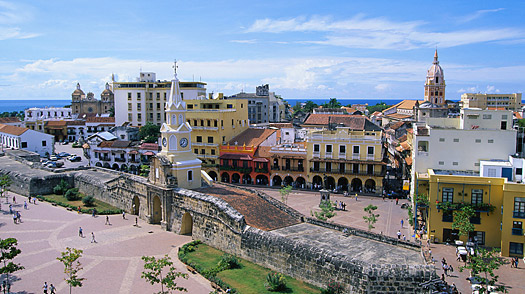
And honestly, Cartagena is probably the most beautiful city in South America, and it's easily one of the most romantic places I've ever been. So... yes. Vacation. Finally.
Ciao! (Below: Cartagena. Imagine it lit up at night, and imagine strolling through little streets with flowered-covered balconies. Didn't I say it was romantic?)
Sunday, September 19, 2010
Melody's Guide to Being Vegan in Colombia: Introduction

Welcome to the beginning of a series of posts about being vegan in Colombia... and let it be known before you read this post that I totally get/understand/don't need to be told that veganism is a choice. It is a personal choice I made over three years ago, but certainly one that I'm freely able to change my mind about. I get it. Don't attack me for it, okay? The point of this post is to talk about something near and dear to me: the challenge of being vegan in Colombia, and how to overcome said challenge.
I really do love Colombia, even when I complain about my job and the other frustrating things that happen here. It's a beautiful country full of truly wonderful people, and I absolutely encourage people to travel here and experience it.
Despite this, Colombia is a very, very difficult place to be a vegan, and even a fairly difficult place to be a vegetarian. The main reason for this is that people don't even really understand vegetarianism, and so veganism is something that confuses most Colombians. This isn't because they are stupid or anything, it's because it is very uncommon for people to be vegan/vegetarian here. Vegetarians in Colombia come in many different versions, too. Some people consider themselves vegetarians if they only avoid red meat. Many vegetarians still consume sustancia (chicken broth) and other kinds of animal products, like gelatin and beef juices. A lot of vegetarians do avoid meat and meat by-products, like broth. Even so, people who work in the food business will not understand exactly what vegetarianism is, generally speaking. For example, if you order beans, there's an extremely high chance that they were cooked with meat. They might not have meat IN them, but they might have been cooked with a bone or meat juices or just big chunks of pork fat. This is very typical, and generally it is safe to assume that most beans served in restaurants are not safe for vegetarians to eat. I've ordered beans before that the cooks swore did not contain meat, and there was a big chunk of pork in my bowl when they were served.
In the States, if I didn't have a lot of time to make a meal, or if I just didn't want to do a lot of prep, there were always lots of alternatives. I could easily eat out, even at a fast food place like Taco Bell (not healthy, but definitely convenient), I could grab a carton of packaged hummus, I could buy a frozen Amy's burrito from almost any grocery store, or I could even cook something using packaged foods, like canned beans or fake meat. Even tofu is less work in the States because you can get it at almost any Thai restaurant OR you can buy packaged, flavored, and pre-cooked tofu at a health food store. At that was in Springfield, not New York City or Portland. In Colombia, being vegan or vegetarian requires a lot of work. It takes a lot more effort to get the necessary amount of protein and calcium in my diet here. It can be exhausting and frustrating to constantly be prepping food just to meet my nutritional needs.
During the next food days I will be posting about what foods to avoid, what foods to eat, where to find vegan products, what to bring to Colombia from the States if you are vegan, vegan recipes, and how to ask questions in Spanish that will help you survive as a vegan in Colombia.

At the Chicago Diner for my birthday last year. Best restaurant ever.
Wednesday, September 8, 2010
Traveling in the Coffee Region of Colombia, Part 2.
Okay, so let's say you've seen Plaza de Bolivar in Pereira, taken the bus to Salento and the Termales, and now you are looking for something else to do. Great!
Since this is the coffee region, I think exploring something coffee-related is fairly crucial to seeing the area. Most people searching for coffee inspiration head to Parque del Cafe, which is a giant theme park devoted to coffee. I must admit, I'm a bad coffee-region resident, because I have never gone. Another popular place is Panaca, which is basically a giant farm. I haven't been there, either. Here's why.
Although people rave about Parque del Cafe and I do intend to go there before we leave, it's still a theme park. That means it's a commercial business, and the money isn't being pumped directly into the pockets of local farmers. It's also very expensive. Plus, since it has roller coasters, ski lifts over the coffee fields, and various other rides, it's a bit inauthentic. I don't doubt that it is fun, it just wasn't the version of Colombia I wanted to share with my family. As for Panaca, well, my guidebook describes it as a place where people from the "city" (i.e. Bogota) go to see what life is like on a farm. Hello, I'm from the Midwest. I know what a farm looks, feels, and smells like. Skip!
So... what did we do instead?
3. Hike through a hillside of coffee!


I researched this part of our trip for a long time, and although we ended up spending a lot of time walking through fields in the rain and we learned way more about coffee than I personally needed to know, it was definitely a beautiful, interesting, and authentic afternoon, which is what I wanted. We went to Hacienda Guayabal, which is near Chinchina. Chinchina is considered the heart of the coffee region, which is considered the heart of the Colombia by many people, so basically, we were knee-deep in the heart of Colombia. Almost literally, as it was a pretty muddy experience! The Hacienda offers tours (call ahead) in Spanish and English. (25,000 pesos for Spanish, 30,000 for English.) The tour takes you through numerous hillsides of coffee and the guide instructs you on every aspect of the coffee making process. Don't be afraid to ask questions, because our guide seemed to be bubbling with information.
At the end of the tour, they gave us a cup of coffee and then a really cool dessert. We also got certificates that said we were now coffee experts!


The next day we had to go to school (what???), but LPV is sort of like a mini adventure all by itself! My brother and his girlfriend had a great time...

And that brings us to number 4: Spend time with the locals.
My family mostly spent time with our friends and our students, but I think that's a pretty safe sample of Colombian people in the coffee region. I mean, I have 16 students alone who are happy to tell you anything you might ever want to know about Colombia. So my family could get to know them better, and so we could hike around in the mud "experiencing" the ecosystems in Colombia (science unit), I took my family and my class on a hike through the school's sendero, or forest path.

5. Experience the flora.

On Wednesday, my family and the entire LPV primary went on a field trip to the Universidad Tecnologica de Pereira (UTP)'s Jardin Botanico... Botanical Gardens. There are a lot of other ways to experience the botanical abundance of Colombia and this region, and I'm not sure this is the first one I would recommend, although it made a decent field trip. It was definitely pretty, but I personally enjoyed Medellin's Botanical Gardens more, and any hike around this region will basically be just as beautiful. The La Florida region (catch a chiva from the center of Pereira) is supposed to be incredible, for example. Even so, it was a fun trip.

6. Go to Juan Valdez Cafe. (McDonald's is optional, but encouraged.)


Juan Valdez is the symbol of Colombia's coffee growers, and Juan Valdez Cafe is truly a fun place to hang out. Great coffee, cute sweatshirts, and wireless internet. It's a must for experiencing the coffee region. Pereira's largest and nicest Juan Valdez is on Circunvalar, which is like our Zona Rosa, and is conveniently located up the street from our new McDonald's. What what.
7. Go to a working farm.


I took my family to a friend's trapiche, which is where they grow sugar cane and process it so it becomes panela, which is then used for desserts and drinks in Colombia. (For more information and to see my post from our visit there last summer, see this post.) I love this place because it's as green as can be... everything is sustainable. The workers live off the farm (and live on the farm), the horses eat the discarded leaves from the sugar cane, the woody substance from the cane provides fuel for the fire, and absolutely nothing is added to the cane. It's just cooked over and over and the molded into panela blocks. Cool!

8. Spend time eating pineapple in Cerritos, or at least see the mansions.
Cerritos is a little town super close to LPV, and many of my students live there. It's known for two things: money and pineapple. For real. A number of huge subdivisions filled with fancy houses have popped up in the past decade. The biggest industry for all the non-nouveau riche is pineapple. Cerritos is supposed to have the best pineapple in Colombia, and it produces more pineapple than any other region of the country. I can attest that it is truly delicious, and worth a stop if you are ever in the area. Cerritos also has some very nice hacienda hotels, and if you are looking for a nice, luxurious place to spend the night, this would be a good area to look. After our trip to the trapiche, the owners of the trapiche took us to one of the local haciendas for dessert, and then drove us to their home in Cerritos for a warm cup of panela.
Since this is the coffee region, I think exploring something coffee-related is fairly crucial to seeing the area. Most people searching for coffee inspiration head to Parque del Cafe, which is a giant theme park devoted to coffee. I must admit, I'm a bad coffee-region resident, because I have never gone. Another popular place is Panaca, which is basically a giant farm. I haven't been there, either. Here's why.
Although people rave about Parque del Cafe and I do intend to go there before we leave, it's still a theme park. That means it's a commercial business, and the money isn't being pumped directly into the pockets of local farmers. It's also very expensive. Plus, since it has roller coasters, ski lifts over the coffee fields, and various other rides, it's a bit inauthentic. I don't doubt that it is fun, it just wasn't the version of Colombia I wanted to share with my family. As for Panaca, well, my guidebook describes it as a place where people from the "city" (i.e. Bogota) go to see what life is like on a farm. Hello, I'm from the Midwest. I know what a farm looks, feels, and smells like. Skip!
So... what did we do instead?
3. Hike through a hillside of coffee!


I researched this part of our trip for a long time, and although we ended up spending a lot of time walking through fields in the rain and we learned way more about coffee than I personally needed to know, it was definitely a beautiful, interesting, and authentic afternoon, which is what I wanted. We went to Hacienda Guayabal, which is near Chinchina. Chinchina is considered the heart of the coffee region, which is considered the heart of the Colombia by many people, so basically, we were knee-deep in the heart of Colombia. Almost literally, as it was a pretty muddy experience! The Hacienda offers tours (call ahead) in Spanish and English. (25,000 pesos for Spanish, 30,000 for English.) The tour takes you through numerous hillsides of coffee and the guide instructs you on every aspect of the coffee making process. Don't be afraid to ask questions, because our guide seemed to be bubbling with information.
At the end of the tour, they gave us a cup of coffee and then a really cool dessert. We also got certificates that said we were now coffee experts!


The next day we had to go to school (what???), but LPV is sort of like a mini adventure all by itself! My brother and his girlfriend had a great time...

And that brings us to number 4: Spend time with the locals.
My family mostly spent time with our friends and our students, but I think that's a pretty safe sample of Colombian people in the coffee region. I mean, I have 16 students alone who are happy to tell you anything you might ever want to know about Colombia. So my family could get to know them better, and so we could hike around in the mud "experiencing" the ecosystems in Colombia (science unit), I took my family and my class on a hike through the school's sendero, or forest path.

5. Experience the flora.

On Wednesday, my family and the entire LPV primary went on a field trip to the Universidad Tecnologica de Pereira (UTP)'s Jardin Botanico... Botanical Gardens. There are a lot of other ways to experience the botanical abundance of Colombia and this region, and I'm not sure this is the first one I would recommend, although it made a decent field trip. It was definitely pretty, but I personally enjoyed Medellin's Botanical Gardens more, and any hike around this region will basically be just as beautiful. The La Florida region (catch a chiva from the center of Pereira) is supposed to be incredible, for example. Even so, it was a fun trip.

6. Go to Juan Valdez Cafe. (McDonald's is optional, but encouraged.)


Juan Valdez is the symbol of Colombia's coffee growers, and Juan Valdez Cafe is truly a fun place to hang out. Great coffee, cute sweatshirts, and wireless internet. It's a must for experiencing the coffee region. Pereira's largest and nicest Juan Valdez is on Circunvalar, which is like our Zona Rosa, and is conveniently located up the street from our new McDonald's. What what.
7. Go to a working farm.


I took my family to a friend's trapiche, which is where they grow sugar cane and process it so it becomes panela, which is then used for desserts and drinks in Colombia. (For more information and to see my post from our visit there last summer, see this post.) I love this place because it's as green as can be... everything is sustainable. The workers live off the farm (and live on the farm), the horses eat the discarded leaves from the sugar cane, the woody substance from the cane provides fuel for the fire, and absolutely nothing is added to the cane. It's just cooked over and over and the molded into panela blocks. Cool!

8. Spend time eating pineapple in Cerritos, or at least see the mansions.
Cerritos is a little town super close to LPV, and many of my students live there. It's known for two things: money and pineapple. For real. A number of huge subdivisions filled with fancy houses have popped up in the past decade. The biggest industry for all the non-nouveau riche is pineapple. Cerritos is supposed to have the best pineapple in Colombia, and it produces more pineapple than any other region of the country. I can attest that it is truly delicious, and worth a stop if you are ever in the area. Cerritos also has some very nice hacienda hotels, and if you are looking for a nice, luxurious place to spend the night, this would be a good area to look. After our trip to the trapiche, the owners of the trapiche took us to one of the local haciendas for dessert, and then drove us to their home in Cerritos for a warm cup of panela.
Well, that's all for my recommendations today. I'm in the middle of finals at school, but I'll try to post again soon.
Subscribe to:
Posts (Atom)
